05
Jun
Friday from 19.00 to 22.00
Hiša kulture v Pivki (Snežniška cesta 2, Pivka)
Hiša kulture v Pivki (Snežniška cesta 2, Pivka)
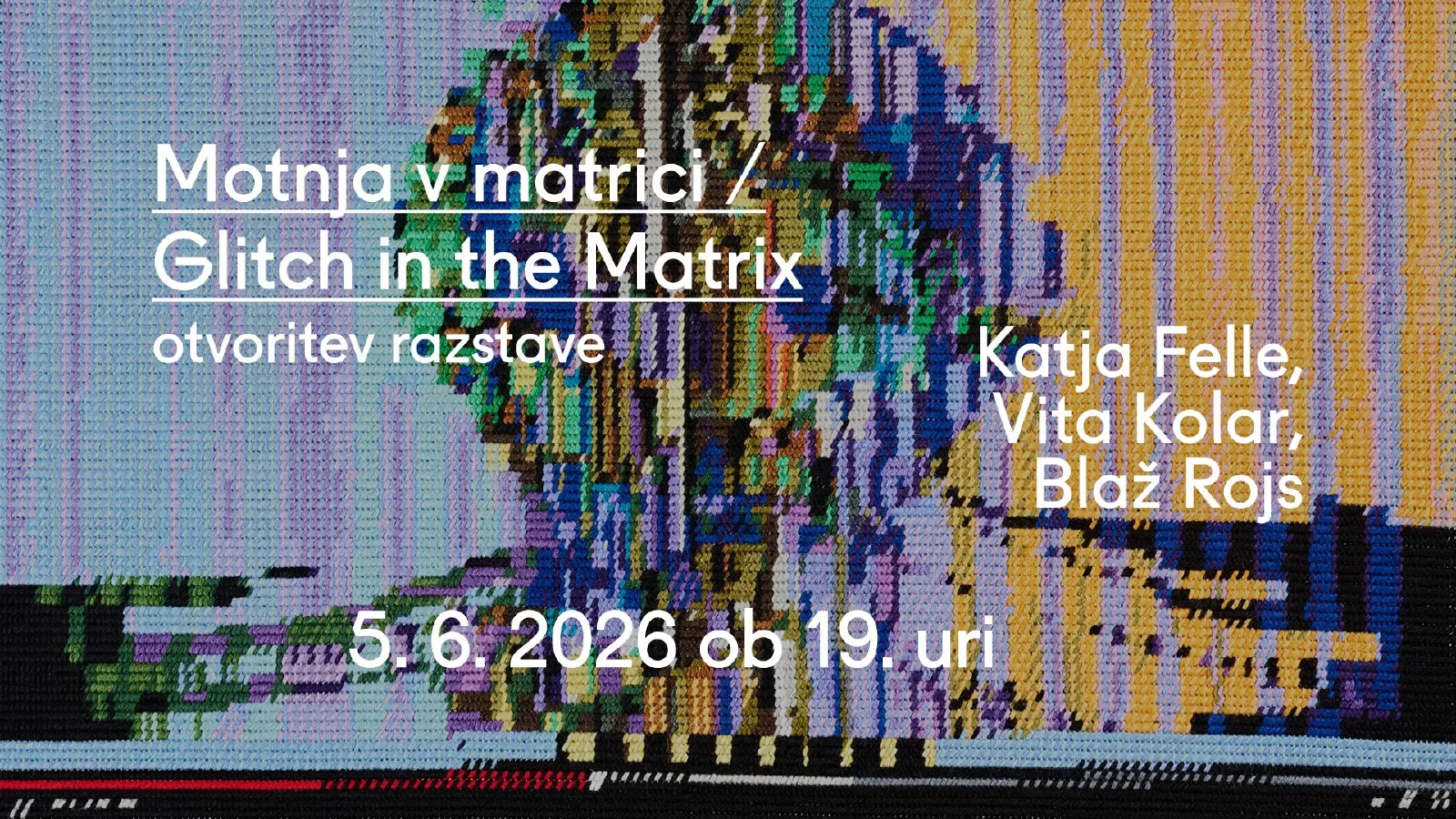
Matrix disorder
We invite you to the opening of the exhibition entitled Disorder in the Matrix
About the exhibition
participants Katja Felle, Vita Kolar, Blaž Rojs
curated by Sara Nuša Golob Grabner
The term "post-internet" is used in the field of art and design to refer to practices that treat the internet and its aesthetics no longer as something new, but as a ubiquitous part of everyday life that is completely fused with our physical lives. Typically, post-internet aesthetics tend to highlight nostalgia for early internet culture, vivid colors, perfectly over-elaborate images, or, conversely, pixelation. Often, the purpose of this kind of aesthetic is to bring about the nostalgic irony associated with consumerism (e.g., vaporwave), to highlight the sense that nothing is simply definable and "real" anymore, and to emphasize the infinity of the Internet, which transcends the capabilities and limitations of the biological body and watches over us as a higher power. One of the distinguishing features of the post-Internet is the glitch, which has taken on the status of a special visual symbol in contemporary art. Rosa Menkam, in her work The Glitch Moment(um), presents at the very beginning of the book 8 rules of the Glitch Studies Manifesto. Roughly, he says, disorder represents the imperfection of any attempt at perfection, the possibility of discovering new combinations, catharsis through disintegration and, above all, the acceptance of the fact that nothing can happen without errors, and that error can be the way in which any media form can be brought to a critical state of hypertrophy in order to criticize its internal politics. It is appropriate to use the word hypertrophy, which generally speaks of an increase in the size of individual cells, which leads to an increase in tissues or organs. In this exhibition, images expand, flicker, intensify and come to life to fullness in brilliant colors. The featured artists navigate the post-internet aesthetic with visual saturation, maximalism, and the embodiment of the non-physical through the physical gesture of the artist. The exhibition functions as a mini-manifesto against visual silence, purification and the division into online and physical reality.
Katja Felle
On the oil canvases from the Cloud series, Katja Felle moves from previously known, fragmented digital images to an abstract fusion of forms and the limitlessness of digital spaces. The complete fluidity of the digital cloud alludes to the perfection of memory technology, which, however, without the mediation and activation of human memory and gesture, is latent, an end in itself, and floats in an interspace where information flows seamlessly into each other before human intervention. In the manual painting of screen images in the classical sfumato technique, a mistake inevitably occurs, and it contradicts the perfect smoothness to which the period when digital content is intangible (time after cassettes, floppy disks, CDs) tends to. The tapestries, in contrast, communicate with pixelation, realized by thread insertion. Noise, playback error, and the inability to uniformly display color on the screen are in dialogue with one of the oldest art genres, and slow down the speed of data transfer to the pace of a human.
Vita Kolář
In the field of digital imaging, Vita Kolar has created a recognizable style, which is often created in parallel with (electronic) music. He enters the creation through an atmosphere that reflects the infinite possibilities of growth, change, and limitlessness between layers, noises, and colors. Each work created can be the starting point for a new variation, for the recontextualization of the image according to the feeling. In this way, the paintings acquire an almost organic quality and form a unified story in the artist's portfolio, with countless outlets swirling in mystical digital landscapes. The images are created with a purely painterly approach to color, composition, line and stylistic distinction of the artist. In part, the nostalgia of the 90s of the last century, when the world glowed in colors and wild patterns, and the Internet experimented with an abundance of new possibilities for visual expression. When viewing the works of Vita Kolar, it is difficult to avoid synesthesia, as the motifs are inspired by sound, movements and textures that open the door to the world of play and liveliness.
Blaz Royce
By reducing and reconstructing, Blaž Rojs creates partially mimetic works that move between abstraction and figuration. It deals with a fundamental phenomenon of contemporary visual culture: the disappearance of evidential certainty. In his paintings, there is no distinction between real and fictional sources: he wonders if such differences still matter at all. By erasing these categories, his paintings reflect the subjective relationship of the individual to truth, memory and visual information that shape our daily lives. We look at the images through the prism of imperfection and disintegration. The central motifs are flooded with sections of other, partially realized images that impose themselves on the original information and negate its integrity. In places, information is completely lost, leaving behind yawning spaces. A portrait can only be represented as a set of hues on the CMYK color gamut and is difficult to see through a cathodic noise grid. In Rojs's work, stability is lost and a new, collective image of consciousness emerges, which treats reality as a constant flow and change through freely available influence.
Check availability on Booking.com
Data: Google


